This is a maximum card with the "Dia de la Madre" (Mother's Day) stamp from Argentina that was issued on October 17, 1959. The card is the size of a standard size postcard, but it has a blank back and is rather thin cardstock. In Argentina, Mother's Day is the third Sunday in October.
There is part of a poem printed in Spanish on the card. The Google translation didn't make much sense to me, and I couldn't find a better translation. Following are translations of other words on the card.
The prompt for Sepia Saturday 92 is a photo of the offices of the London & North Western Railway Company. The United Kingdom had the London & North Western Railway. The United States had the Chicago & North Western Railway (CNW). The above postcard shows the exhibit of the Chicago & North Western Railway at the San Francisco World's Fair, the Golden Gate International Exposition of 1939 and 1940. Below is the description of the back of the exposition postcard: Route of the "400", the [CNW] Streamliners and the Challengers.
The Chicago & North Western Railway, also known as the North Western, became one of the longest railroads in the United States as a result of mergers with other railroads. The North Western operated some long distance passenger trains in conjunction with Union Pacific and Southern Pacific, including the Overland Limited, City of Los Angeles, City of San Francisco, City of Denver, and the Challenger. The company was purchased by Union Pacific Railroad in 1995 and ceased to exist in 1996.
The North Western's most famous train was the "400" from Chicago to Minneapolis/St. Paul that was introduced in 1935. This train was named the "400" because it traveled the 400 miles (640 km) between the cities in 400 minutes. In 1939 the "400" was modernized with new diesel locomotives and streamlined cars. The first "400" was later renamed the "Twin Cities 400" and CNW labeled most of its other passenger trains with variations of the "400" name. CNW stopped running the Twin Cities 400 in 1963, and all CNW intercity passenger service ended with the formation of Amtrak in 1971.
The following postcards were published in 1939 and show the then new Chicago and North Western Line streamliner "400." The descriptions below the images are copied from the postcards.
NORTH WESTERN'S NEW "400" STREAMLINER OPERATIING DAILY BETWEEN CHICAGO AND ST.PAUL-MINNEAPOLIS VIA MILWAUKEE
Powerful Diesels provide a smooth flow of power and new type shock absorbers on the trucks of the new "400" Streamliners insure a smooth ride.
TAPROOM IN THE TAVERN-LUNCH COUNTER LOUNGE CAR OF THE NEW "400"--INSERT, POPULAR LUNCH COUNTER
The most unusual car in America--a taproom at one end, lounge at the other and in between an attractive Lunch Counter serving moderately priced meals. Speedometer over the bar, Radio and deep-cushioned chairs and sofas in the lounge. Photo-mural decorations.
COACHES ON THE NEW "400" ARE A REVELATION IN COMFORT AND BEAUTY
Comfort to the point of luxury! Latest type seats--with plenty of room between. Solex glareless glass, draftless air-conditioning, Stewardess Service, Smoking and Powder Rooms.
COLORFUL DINING ROOM ON NORTH WESTERN'S NEW "400"
You will enjoy a "400" dinner in the delightful atmosphere of the richly appointed Dining Room on the new "400" Streamliner.
ULTRA MODERN PARLOR CARS ON THE NEW "400"
The Parlor Cars on the new "400" are equipped with special new type rubber cushioned seats adjustable to any position. Each car has Powder Room, Smoking Room, Drawing Room and Photo mural decorations.
THE FAMOUS "400" OBSERVATION-LOUNGE CAR--SPEEDOMETER IN THE OBSERVATION SECTION SHOWN IN INSERT
Cozy lounging chairs, card tables, a magazine table with current periodicals, radio, bar, speedometer, are all features of the beautiful Observation Lounge Car on North Western's famous "400" Streamliner between Chicago and St. Paul - Minneapolis (via Milwaukee.)
The following video is an educational documentary by the Chicago & North Western published in 1948 to celebrate the railroad's 100th anniversary.
This circa 1911 postcard shows the five Minneapolis public high schools in existence at that time.
Central High School. Located at at 11th Street and 3rd Avenue South. Opened in 1877. Replaced with a new school at 4th Ave S. and 34th St. in 1913. New building closed in 1982.
South High School. Located at at Cedar Ave and E 24th. Opened in 1892. Building was significantly changed by 1916 with additions and replacements in several styles.
West High School. Located at Hennepin Ave and W 28th. Opened in 1909. Closed in 1982.
North High School. Located at 17th Ave, N. between Girard and Fremont Avenues. Opened in 1896. Additions added in 1908 and 1910. Reconstructed after a 1913 fire and replaced with a new school 1972-73.
East High School. Located on Central Ave. between University Ave. SE and 4th St. SE. Opened in 1866 as Winthrop. Closed in 1889. Reopened as East High in 1900. Closed in 1924.
This is a postcard picturing the 22-cent stamp commemorating the 10th Pan American Games that was issued on January 29, 1987. The games took place in August, 1987 at various sites in the state of Indiana, with most of the events being held in Indianapolis. Over 6,500 athletes and officials from 38 nations took part in the these games.
The first Pan American Games were in 1951. Athletes from Western Hemisphere nations participate in the games. The Pan American Games are held every four years in the summer, one year before the Summer Olympics. They were last held in Rio de Janeiro, Brazil in 2007. The 2011 Pan American Games will be held in Guadalajara, Mexico and nearby cities from October 14–30. Approximately 6,000 athletes from 42 nations are expected to participate in 36 sports. The 2015 games will be in Toronto, Canada.
I love the design of this Pan American Games stamp. It features a stylized representation of a sprinter composed of various geometric shapes. The runner's image is repeated in successively fainter shades from right to left. The style reminds me of Duchamp's Nude Descending a Staircase, Futurism, and also anatomical drawings of the muscular system.
The above postcard shows passengers standing on the observation car platform of an early twentieth century Burlington Limited train. The feature of this postcard that I find most interesting is the message written en route by a passenger referring to the observation platform:
8-5-08. - Got up at 5 A.M. and went out on this observation platform to see the sun rise. Have just passed through Lincoln, Neb. Am writing this on a rapidly moving train, hence the nervous hand writing. ("Believe me")
This postcard was postmarked in Holdrege, Nebraska. Holdrege still has the historic railroad station that was opened in 1910 by the Chicago, Burlington, & Quincy Railroad. The Holdrege Station is one of the five Nebraska stations served by Amtrak.
On this and other older railroad observation cars, the rear end of the car had a canopied open porch-like area. There was usually a lounge inside the rear of the car where passengers could watch the track recede into the distance.
Later observation cars were usually enclosed and had a rounded rear end with viewing windows. Most observation cars were removed from service on American trains beginning in the 1950s in order to eliminate the need to "turn" the trains for service in the opposite direction. The next postcard shows a streamlined observation car on the Seaboard Railroad's Silver Meteor. This type of car was built in 1947 and was used by Seaboard even after other U.S. railroads had removed the observation cars as uneconomical.
The Burlington's Twin Zephyrs between Chicago and the Twin Cities (St. Paul-Minneapolis) were the first dome streamliner trains in 1947. The next postcard shows a Twin Zephyr with a round end dome parlor observation car.
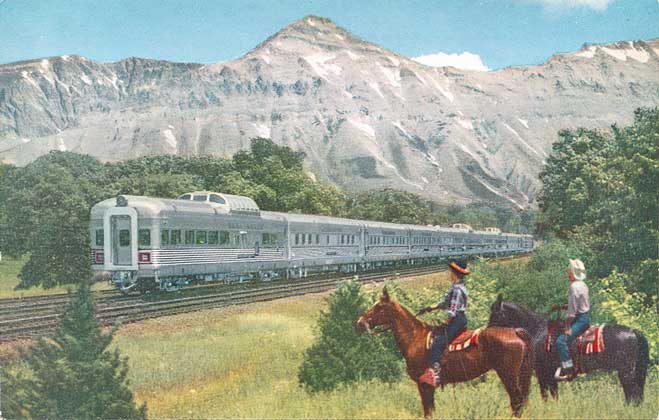
The postcard below shows the Denver Zephyr between Chicago and Denver with a newer type of blunt end dome parlor observation lounge car. [note: I have seen a picture of the train and horseback riders in a book without the mountains, and the picture was said to have been photographed in Illinois!]
When passenger trains were still the main mode of intercity transportation in the United States, observation cars were often used by political candidates. The candidate would make a "whistle stop" tour stopping in various cities. At the stops, the candidate would appear on the platform of the observation car and give a speech. In more recent years, several U.S. presidents have used a privately-owned observation car built in 1930.
Barack Obama used a train with an observation car twice. The first time was during his campaign in April 2008. The second time was for his inaugural weekend trip from Philadelphia to Washington, D.C. that traced the last part of Abraham Lincoln's inaugural journey to Washington.
First I have a 1985 postcard from Greenland showing a stamp that was issued that year. The words at the top of the postcard and the stamp Kalaallit Nunaat mean "Land of the Greenlanders." Reinhardtius hippoglossoides is the name of the fish that is pictured, also known as the Greenland halibut or Greenland turbot. This is a deepwater fish mainly found in water with temperatures from 1-4 °C.
Greenland is an island that is located between the Arctic and Atlantic Oceans. Physiographically it is a part of the continent of North America, but it is an autonomous country within the Kingdom of Denmark.
The back of the postcard has an address to write for further information about Greenland stamps. Now you can find information about Greenland stamps on the web at stamps.gl.
I received an envelope in the mail this week with a colorful fish stamp, so I scanned that too. This is a 39-cent stamp that was issued in 2006. It shows the Longest Reef (off the Florida Keys) and is one of the forty stamps on a sheet "Wonders of America: Land of Superlatives." The superlatives include natural and man-made wonders that are the longest, tallest, largest, fastest, etc. in the United States .
Above is an oversize postcard describing some of the history of the Union Pacific Railroad (click the image to enlarge it to readable size). Below is a video slideshow I made with my Union Pacific Railroad postcards.