Saturday, August 13, 2011

Salute to Youth


This stamp saluting young America was issued August 11, 1948 to commemorate National Youth Month of September 1948. The First Day ceremony was held at the White House in Washington, D.C. and was hosted by President Harry Truman.

National Youth Month was conceived as part of a campaign to combat juvenile delinquency. In announcing this stamp, the Postmaster General declared, "America looks to its youth of today, because the future destiny of this country depends in large measure on the younger generation. Only by continuing to recognize the importance of the men and women of tomorrow can America maintain the strong bulwark of freedom that is today."

The stamp design shown below is from the U. S. Post Office Department Stamp Design Files. This design was criticized as being nothing more than a billboard poster. It certainly is less intricate than most other U. S. stamps of that era.


I don't know whether National Youth Month was celebrated in other years. It doesn't appear to be celebrated today.

There is an International Youth Day on August 12 each year. It was designated by the United Nations in 1999 and was first celebrated in 2000. It is meant as an opportunity to draw attention to youth issues worldwide. The year from International Youth Day 2010 to International Youth Day 2011 was designated International Year of Youth by the United Nations. This was the 25th Anniversary of the first International Year of Youth.

I am participating in Sunday Stamps at Viridian's Postcard Blog


Thursday, August 11, 2011

Romantic Couples


And when the day's ended you'll wait on our pourch
And the smile on your face will be my life's tourch


To show him, that there's nothing wrong,
She kisses long her lover strong.


Postcards showing romantic couples were popular during the postcard craze of the early twentieth century. These two were produced by the Theodor Eismann company in Germany circa 1910. On the back, they are marked in the bottom left corner with the company logo, a combination of a comet with the intertwoven initials Th.E.L.

Printed on the bottom of the right side is Th.E.L. „Theochrom” Serie N0 1124 (or Serie N0 1091 on the second card). “Theochrom” was their process name for a glossy lacquer finish. Postcards like these typically were published in series. The romantic series usually featured the same models in a sequence of poses acting out the words on the card.

The video below shows "The Romantic Postcard of the early 20th century in the social context of the time and what women had to consider before marrying as marriage was at that time for life."


Visit Sepia Saturday for More Vintage Photos


Monday, August 8, 2011

Old Minneapolis Postcards Video


Above is a typical back from a postcard view published by Acmegraph Co., Chicago. Acmegraph was one of the main publishers of Minneapolis views on postcards early in the twentieth century.

Below is a new video, Old Minneapolis Postcards - Volume 1, that I made with Windows Movie Maker. All the postcards in this video were published by Acmegraph Co. The emphasis in this group of views is on the downtown area of Minneapolis. This video is labeled "Volume 1" because I plan to make more videos of Minneapolis postcards.


Saturday, August 6, 2011

Liechtenstein Stamps


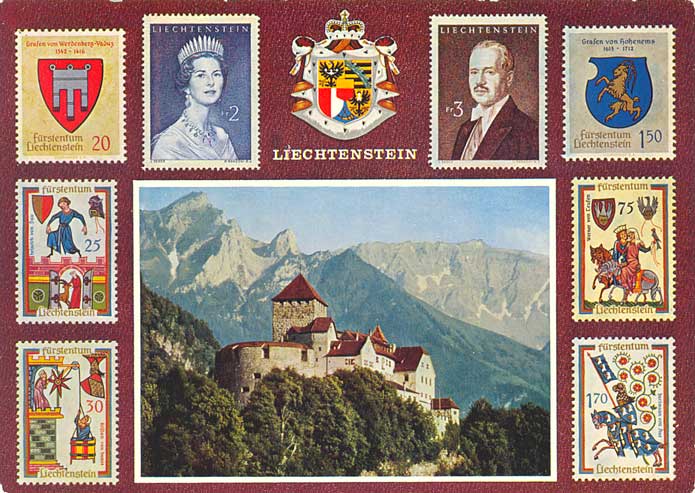
Here are two postcards featuring stamps of the principality of Liechtenstein. The postcards share a common image of the Vaduz Castle in their centers. Vaduz is the capital of Liechtenstein, and Vaduz Castle is the most prominent landmark of Vaduz. The castle is the official residence of the reigning prince of Liechtenstein and his family.

The first postcard was mailed in 1966, and one of the stamps used also shows Vaduz Castle. The two stamps pictured in the top row center of the postcard show Princess Gina and Prince Franz Joseph II. Prince Franz Joseph II was the Sovereign Prince of Liechtenstein from 1938 until his death in 1989. The current reigning Prince of Liechtenstein is Hans-Adam II, the son of Franz Joseph II.

The stamp in the top left corner of the second postcard is the oldest and shows Prince Johan II who reigned 1868-1929 . It is from the period of Austrian administration of the post office. Since 1921 the post office has been administered by Switzerland.


I am participating in Sunday Stamps at Viridian's Postcard Blog


Wednesday, August 3, 2011

Cow Exhibits at A Century of Progress Exposition


Chicago was the host of two international expositions. The first was the Worlds's Columbian Exposition of 1893. The second was A Century of Progress International Exposition held in 1933 and 1934. The postcard and pictures in this post are all from the Century of Progress and show the cow exhibits there.

The first image (above) is a postcard from the International Harvester Company dairy exhibit in the Agricultural Building. A mechanical cow was used to demonstrate the McCormick-Deering milker. This cow was a reproduction of a Holstein that chewed its cud, moved, breathed and gave milk that could be seen through a window in the pail of the milker.

The Dairy Building was filled with dairy exhibits starring the cow as "Our Foster Mother." The next three pictures are from a souvenir book showing many of the exposition exhibits and buildings. The first picture is of the Dairy Building exterior.


The next picture is of a mural and a mechanical cow with its insides representing "nature's greatest food factory." This cow consumed roughage and turned it into milk.


The next picture claims to show the difference in growth and size when an animal was fed milk. (Believe it or Not!)


The last picture is a page from an article in the Official World's Fair Weekly. (Click the picture to enlarge it to readable size.)


Visit Sepia Saturday for More Vintage Photos


Welcome to Brazil - Indiana, USA


Brazil, Indiana was founded in 1866. It received its name from a local farm that was named Brazil. The farm was given its name in the 1840s because Brazil was often in the news at the time.

This colorful billboard is probably from the late 1950s or 1960s. The famous "Chafariz Dos Contos" is still there. This is a fountain that was a 1956 friendship gift from Brazil, South America. It is a replica of a fountain built in 1745 in Ouro Preto, Brazil.

The billboard advertised that Brazil was the "clay products center of the world." Brazil is no longer a clay products center, but in the past there were nine clay product plants within a couple of miles of Brazil. The plants made products like electrical conduits, hollow tile, silo block, face brick, interlocking brick and block, paving brick, sewer pipe, wall coping, chimney tops and bowls, segment blocks, fire clay stove pipe fittings, flue lining, drain tile and common brick.


I'm participating in Signs, Signs


Monday, August 1, 2011

Cooling Off at Lake Nokomis, Minneapolis


The Minneapolis lakes must have been especially inviting in the days before air conditioning.

Lake Nokomis is one of the lakes in the city of Minneapolis, Minnesota. The following information on Lake Nokomis is from Wikipedia:
The lake was originally named Lake Amelia in honor of Captain George Gooding’s daughter, Amelia, in 1819. Its current name was adopted in 1910 to honor Nokomis, grandmother of Hiawatha (legendary Indian hero of Henry Wadsworth Longfellow's poem, The Song of Hiawatha). The lake has an area of 204 acres (0.83 km2).When purchased in 1907, the lake was very shallow, only 5 feet (1.5 m) deep in the deepest spot. Much of it was actually marshland or slough -- a drainage area for the neighborhood. It was deepened by dredging to produce the current lake.
These lines are from Longfellow's Song of Hiawatha:
By the shores of Gitche Gumee,
By the shining Big-Sea-Water,
Stood the wigwam of Nokomis,
Daughter of the Moon, Nokomis.
Dark behind it rose the forest.


Related Posts Plugin for WordPress, Blogger...