Showing posts with label crafts. Show all posts

Thursday, March 3, 2016

Cuernavaca Earthenware


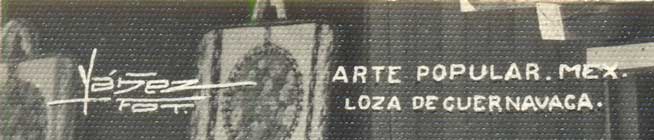
This is a real photo postcard of arte popular (folk art) for sale in Cuernavaca, Mexico. The title Loza de Cuernavaca translates as  "earthenware Cuernavaca." The name of the photo studio, Yañez Fotografica, appears in the upper left hand corner. The only information that I could find about this studio was in a listing of some postcards that stated "these wonderful old photo postcards are of Cuernavaca by the famous Yanez Fotografica studio, which photographed Mexico from around 1900 until circa 1930."


The photo is printed on Agfa postcard photo paper. This back is different from the Agfa backs generally used in the United States. I only was able to find a couple of used/dated postcards with this style of back, 1930 and WWII era.


To See More Vintage Images


http://sepiasaturday.blogspot.com/2016/03/sepia-saturday-320-5-march-2016.html


Friday, October 17, 2014

Mexican Pottery


I like postcards showing crafts and markets, and the postcard above fits both those categories. It shows the market at Tlacolula, Oaxaca, Mexico, described as "One of Mexico's most famous pottery markets."

The next postcard shows Doña Rosa (1900-1980) in Oaxaca, Mexico. She was famous for inventing a technique to make the local pottery type, barro negro, black and shiny after firing. You can watch her at work in a video here.


The next postcard is one of my favorites because it includes a woman photographing the scene with what appears to be a 1950s Brownie movie camera, similar to the one in the vintage Kodak commercial video at the end of this post. The location is somewhere south of the Rio Grande border between Texas and Mexico.


My last postcard shows a piñata shop, apparently just south of the border between Arizona and Mexico. Piñatas are decorated containers often made of papier-mâché, pottery, or cloth. They are filled with small toys or candy, or both, and then broken as part of a ceremony or celebration. I am including it to help us celebrate Sepia Saturday’s 250th Edition with a party!


Just think of all the things you could record with a Kodak movie camera--and it's such a bargain!


http://sepiasaturday.blogspot.com/2014/10/sepia-saturday-250-18-october-2014.html

Thursday, June 13, 2013

Native American Jewelry


Native Americans of the Southwest United States are famous for their jewelry, especially that made with silver and/or turquoise.

The postcard above (ca. 1932) shows a little Navajo girl and is titled "The Silversmith's Daughter." According to the description on the back of the card, her beautiful Indian jewelry made of coin silver and genuine turquoise stone has been lavished upon her by her silversmith father.

The postcards below are somewhat newer (ca. 1958-63). The first shows an Indian silversmith at work using primitive tools to make jewelry of coin silver and turquoise. The silver is heated and then hammered to suit his purpose. 


Many examples of genuine Indian handmade jewelry are shown on the last two postcards.


The video below is long, but it is well-worth watching. It shows and describes the different styles of Native American silver jewelry that are associated with different tribes and gives a brief history of the jewelry.


For More Vintage Images


Tuesday, July 24, 2012

Pan American World Airways - Mexican Crafts


Pan American World Airways issued this advertising postcard circa 1948. The description is written in three languages: "Skilled silversmiths and expert weavers exhibit their wares in Mexico, on the routes of the Flying Clippers."

A handwritten message on the back says: "Having a wonderful time. Everyone is expecting you down here in July."


Thursday, January 19, 2012

Rag Dolls


First I have a postcard of a pair of rag dolls made and painted in 1932 by Grandma Moses (Anna Mary Robertson Moses) for her granddaughters, Zoeanna and Frances Moses. The postcard is from the Bennington Museum Collection, Bennington, Vermont which has he largest public collection of Moses' paintings in the country. Grandma Moses (1860 - 1961) was a popular American folk artist who began painting in her seventies and by the time of her death had created over 1500 works of art.

Next I have a photo of myself with a rag doll. I think this doll looks really cute, but I don't remember it at all. I do vaguely remember a very large rag doll I had. That one was named after me because it was about the same size as me.


Fast forward to the 1980s when I was into country stuff. The pair of rag dolls below are ones I made in 1986. I made three of these--one for myself and two for Christmas presents. This photo was taken at Christmas and shows the dolls in an antique rocking chair.


I made these dolls from a Kentucky Rag Doll pattern that was in a Better Homes and Gardens Christmas 1982 magazine. I still have this magazine. The cover shows the Kentucky Rag Doll in the basket with other Christmas items. I also made the cross-stitch stocking that is pictured in the lower left corner of the magazine cover.


A few years later I started a collection of rag and other folk dolls. After collecting them for several years, I had to stop collecting them due to a lack of display and storage space.


Visit Sepia Saturday for More Vintage Images


Thursday, April 28, 2011

Bily Brothers Clocks - Spillville, Iowa


Frank and Joseph Bily were brothers who were Iowa farmers and carpenters. They carved clocks for a hobby beginning in 1913. For over 30 years they made intricate hand-carved clocks depicting history, art, religion and culture. Their clocks are made of many different woods. Most of the clocks have chimes and movable wood-carved figures. Some of the clocks are ten feet high.

The Bilys never sold any of their clocks. They bequeathed their clocks to the town of Spillville, Iowa, where their whole clock collection can still be seen in the Bily Clocks Museum.

The first clock below is the Apostles' Parade Clock, representing a Gothic Cathedral that was carved in the years 1921 and 1922. It is made of walnut, maple and two kinds of rosewood. Twelve Apostles parade to a set of chimes.


The next clock is the Paradise Clock, carved in the years 1934 and 1935. It is carved in butternut, oak and white ash woods.


Addendum:

By coincidence I acquired an older black & white postcard of the Bily Clocks a day after I wrote this original post. According to this card, the clocks were in Ridgeway at the time. However, the back of this card has a handwritten note that says "Trip to Spillville to see the clocks. Feb'y 5, 1939." The Bily farm was between the small towns of Ridgeway and Spillville. The clocks were moved to Spillville in 1946.


Visit Sepia Saturday for More Vintage Photos


Wednesday, November 3, 2010

VTT - National Handcraft Garden Medley Apron


I have seen many postcards showing craft kits from National Handcraft Institute of Des Moines, Iowa. There is quite a bit of unused stock in the hands of postcard collectors and dealers. Until recently I assumed that these postcards were made to be mailed as advertisements. Now I think that most (possibly all) were made to be placed in the corresponding kit to show the completed product.

Some of the complete unused kits are also available on eBay and elsewhere, and most of pictures of the kits I have seen include the postcard. The front of the Garden Medley Apron kit postcard is shown above. The description below is from the postcard back. I find the descriptions on the postcards very amusing--the copywriters really got carried away.


Below is a picture of the complete unassembled apron kit and a scan of the first page of the directions (with even more of their amusing copy). These are "Copyright 1971, Fad-of-the-Month Club, Div. of NATIONAL HANDCRAFT INSTITUTE, INC., Des Moines, Iowa."


I'm participating in Vintage Thingie Thursday

Wednesday, September 15, 2010

VTT - Crazy Quilt Made From Vintage Neckties


The first picture is a postcard showing a detail of an old crazy quilt that was photographed during the Blue Ridge Parkway Folklife Project in 1978. The project was conducted by the American Folklife Center, in cooperation with the National Park Service.

In 1985, I read the book Crazy Quilts by Penny McMorris and was inspired to make my own crazy quilt using neckties. At that time it was possible to find many fancy wide ties for cheap prices in thrift stores. Many of the ties of the 1970s were wide and had fancy woven patterns that reminded me of the fancy fabrics and embroidery used during the crazy quilt craze (about 1880 to 1910).

My quilt is made from polyester ties which I found more satisfactory than silk because they were easily washed. I took the ties apart and placed batches of them in a zippered pillow case to wash them in a washing machine. After pressing, the ties were ready to use.


The quilt is approximately 60" X 74". It is made up or twenty 13-1/2" squares. Each patchwork square was made on a muslin backing. The patches were machine stitched in place. After the first patch, each additional patch was added by placing it against the previous patch with right sides together. A seam was sewn through both patches and the backing, then the new patch was flipped right side up and pressed.

Solid color ties were used for the border. Simple embroidery stitches were used between the individual patches and between squares. Embroidery floss was used within the squares. Number 5 pearl cotton was used between the squares and on the border. The quilt backing is a forest green flannel sheet. The top and the back are tied together with pearl cotton every 6-3/4", with the ties showing only on the back.


The book Crazy Quilts by Penny McMorris was published in 1984. It is probably the most interesting books on quilts I have seen, and I recommend it to anyone interested in reading about or making a crazy quilt.


I'm participating in Vintage Thingie Thursday

Friday, July 30, 2010

PFF - Pendarvis Friendship Quilt


This friendship quilt is made up of blocks in the "tumbling blocks" pattern. It was made by Evelyn Kitto wife of the Pendarvis historic site curator, Mineral Point, Wisconsin. It contains over 900 diamond-shaped pieces with signatures representing 500 local people.

This postcard is not dated. The caption on the back is "Pendarvis Bicentennial Quilt." I am not sure whether this quilt was made for the United States Bicentennial in 1976 or for some other bicentennial. If you know when this quilt was made, please let me know.

Related Posts Plugin for WordPress, Blogger...