Showing posts with label video. Show all posts

Wednesday, May 31, 2017

Trees Poem


wooden postcard, 3/16" thick


A famous Trees poem , which has been widely reproduced, is printed on this wooden postcard:
I think that I shall never see
A Poem lovely as a tree.
A tree whose hungry mouth is prest
Against the earth's sweet flowing breast;
A tree that looks at God all day,
And lifts her leafy arms to pray;
A Tree that may in summer wear
A nest of robins in her hair;
Upon whose bosom snow has lain;
Who intimately lives with rain.
Poems are made by fools like me,
But only God can make a tree.

The Trees poem was written by Joyce Kilmer in 1913. Joyce is usually a woman's name, and I pictured Joyce Kilmer as a middle-aged woman. However, Joyce Kilmer was actually a young man, who died a few years later during World War I.

The poem was later set to music and has been recorded by a number of artists, including the Platters.who recorded it in 1961.


This postcard was mailed from Tennessee in September, 1942 with the following message on the back:

How does it feel to be back on the job again?
Happy that Minn won again. Hope they beat Bierman's Cadets.
We spent all day hiking in the Smokies — very beautiful.


"Minn" refers to the University of Minnesota and "the Smokies" refers to The Great Smoky Mountains, a mountain range along the Tennessee-North Carolina border in the southeastern United States.

I was really puzzled by the reference to "Bierman's Cadets."  Bernie Bierman was a famous University of Minnesota Gophers football coach, so I didn't understand how Minnesota could beat his "Cadets."  I discovered that Bierman was the University of Minnesota football coach from  1932 to 1941 and from 1945 to 1950, but during World War II he served in the Armed Forces. In 1942, he was the coach of the Iowa Pre-Flight Cadets..The Iowa Pre-Flight Seahawks represented the U.S. Navy pre-flight school at the University of Iowa in the college football seasons of 1942, 1943, and 1944.

I found a reference to the Minn vs. Iowa Cadets game in a Tulane University football program: "Picking anyone over the Gophers seems odd. It's a case of the teacher outsmarting the student. A shaky vote for Bernie Bierman's Cadets over his former team." The game was played on October 3 , and the Iowa Cadets beat the Minnesota Gophers 7-6.

To View More Vintage Images

http://sepiasaturday.blogspot.com/2017/05/sepia-saturday-370-saturday-3-june-2017.html


Sunday, July 12, 2015

Pan-American Games Stamp -- Winnipeg, 1967


This postcard shows a reproduction of the Canadian stamp commemorating the 1967 Pan-American Games held in Winnipeg. the logo of the games is on the bottom right of the stamp. The Pan-American Games (also known as the Pan Am Games) is a major sporting event in the Americas featuring summer sports, in which thousands of athletes from nations of the Americas compete. The games are held every four years in the year before the Summer Olympic Games.


The postcard was mailed with this commemorative stamp. 1967 was the year of the Canadian Centennial. The centennial logo 1867-1967 is in the bottom right corner of the postcard back.


 The 1999 Pan American Games were also held in Winnipeg. Currently, the 2015 Pan-Am Games are being held in Toronto, Canada, July 10-26. The Games are hosting 6,135 athletes representing 41 National Olympic Committees (NOCs), marking the largest multi-sport event hosted in Canada, in terms of athletes competing.[1] A record of 45% of competitors are expected to be women, the most ever for any multi-sport event.[2] The Games' program consists of 364 events in 36 sports, which includes the 28 sports that will be contested at the 2016 Summer Olympics. (source: Wikipedia)


This is a post for Sunday Stamps at

See it on a Postcard

Thursday, July 2, 2015

The First Ladies at the Smithsonian


Dress of Martha Washington
Wife of President George Washington (1789-1797)


Dress of Sarah Childress Polk
Wife of President James Polk (1845-1849)


Dress of Mary Todd Lincoln
Wife of President Abraham Lincoln (1861-1865)


The postcards above show the dresses of three First Ladies of the United States at the Smithsonian Institution  in Washington D.C, a group of museums and research centers administered by the Government of the United States.  It was originally organized as the "United States National Museum." These postcards were published in the 1930s. 

The First Lady of the United States is the White House hostess and is normally the wife of the President of the United States. The First Lady is not paid a salary and has no official duties. However, she attends many official ceremonies and functions of state either along with or in place of the president. (source: Wikipedia)

The First Ladies Exhibit at the Smithsonian explores the unofficial but important position of first lady and the ways that different women have shaped the role to make their own contributions to the presidential administrations and the nation. The first ladies exhibit has long been one of the most popular attractions at the Smithsonian Institution. It includes many of the gowns worn by First Ladies. Over the years the exhibit has been expanded and updated.


To See More Vintage Images

http://sepiasaturday.blogspot.com/2015/06/sepia-saturday-286-4th-july-2015.html


Friday, June 12, 2015

Needle's Eye Tunnel -- South Dakota


This postcard of the Needles Eye Tunnel is part of a circa late-1930s series of postcards about locations along the Burlington Route railroad. The back of the postcard advertises a side trip by motor to the Black Hills that could be combined with rail trips to several destinations in the American West..


The Needles Eye Tunnel is a narrow tunnel along Needles Highway, a segment of South Dakota Highway 87 highway. This highway is considered one of the most scenic in the United States. Its name came from the needle-like granite formations along the road. The tunnel was named for a spectacular nearby rock formation resembling the eye of a needle.

Below are a contemporary photo of the Needles Eye Tunnel and a video of a drive along the Needles Highway that includes views of the tunnel (at about 1:35)  and the Needles Eye (at about 1:59).


source: Wikipedia


To View More Vintage Images

http://sepiasaturday.blogspot.com/2015/06/sepia-saturday-283-13-june-2015.html

Thursday, May 28, 2015

Old-Fashioned Kitchens


My first postcard contrasts the old-fashioned Colonial era kitchen to the new style available in the early twentieth century. It's statement that "Woman today can be good cooks without spending as much time and energy in the kitchen as their grandmothers did" is still true a century later.

The next postcard shows the early twentieth century "modern" style kitchen with up-to-date conveniences and "a place for everything"


A free-standing kitchen cabinet was the latest in conveniences in 1911, but was hopelessly outdated by the 1950s.The next postcard is from 1954. By then, cabinets were built in. Iceboxes had been replaced by electric refrigerators, and wood-burning stoves had been replaced by gas and electric ranges. That's a lot of change in only about 40 years. The 1950s kitchen still looks fairly modern to me, but many people now would consider it very old-fashioned.


Today's new kitchens are different in style, but in many ways seem less "modern" than the 1960s kitchen shown in the video below. I wonder if and when computerized and interactive appliances will really become popular. I certainly don't want my refrigerator to order my groceries!


To View More Vintage Images

http://sepiasaturday.blogspot.com/2015/05/sepia-saturday-281-30-may-2015.html

Thursday, May 21, 2015

Dance Marathon


I identified this photo postcard as a dance marathon on the basis of the sign in the upper left corner "THEY HAVE BEEN GOING 479 HOURS." That's nearly 20 days!

HistoryLink.org has an excellent article Dance Marathons of the 1920s and 1930s.
Dance Marathons (also called Walkathons), an American phenomenon of the 1920s and 1930s, were human endurance contests in which couples danced almost non-stop for hundreds of hours (as long as a month or two), competing for prize money. Dance marathons originated as part of an early-1920s, giddy, jazz-age fad for human endurance competitions such as flagpole sitting and six-day bicycle races. Dance marathons persisted throughout the 1930s as partially staged performance events, mirroring the marathon of desperation Americans endured during the Great Depression. In these dance endurance contests, a mix of local hopefuls and seasoned professional marathoners danced, walked, shuffled, sprinted, and sometimes cracked under the pressure and exhaustion of round-the-clock motion.
The blog Blondie Cuts a Rug has another informative article with the same title, and many photos from dance marathons.

I don't know when or where the dance marathon on my postcard occurred. The names Rustic Inn, Eddie, and Cloris could be clues. A couple of Eddies are listed on the Dance Marathons page of Dance history Archives, but Eddie is a common name. Rustic Inn is also a fairly common name that is still in use at a variety of places.  I found the postcard in Minnesota, so Minnesota is a possibility. I checked a page about Minnesota marathon dances. There are some interesting photos there, but nothing like this.


To View More Vintage Images

http://sepiasaturday.blogspot.com/2015/05/sepia-saturday-280-23-may-2015.html


Friday, April 10, 2015

NYWF: Pennsylvania Anthracite Coal Exhibits


New York World's Fair State of Pennsylvania Replica of Independence Hall housing Giant Anthracite Wall


New York World's Fair Giant Anthracite Hard Coal Wall in the State of Pennsylvania Exhibit

New York World's Fair Anthracite Hard Coal Exhibit in Home Centre Building

New York World's Fair Automatic Anthracite Stokers for home heating in Home Centre Building

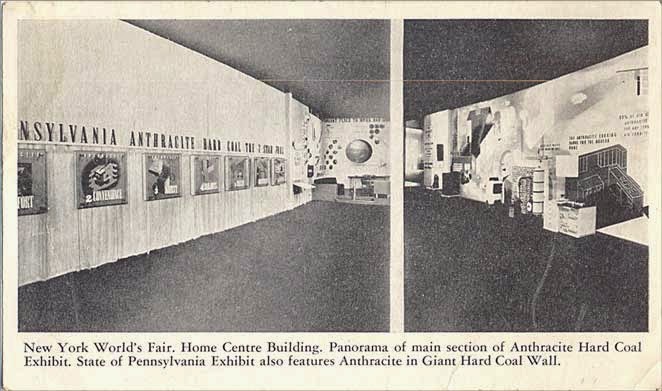
The four postcards above are from the State of Pennsylvania exhibits at the 1939-1940 New Work World's Fair. The exhibits featured Anthracite Coal, an important Pennsylvania product. Anthracite is a hard coal that differs from ordinary bituminous coal by its greater hardness, its higher relative density, and luster.

Here are some facts about Anthracite formation gleaned from the subtitles on a 1920s silent film video, Anthracite Coal Mining circa 1920  (this video is informative but somewhat tedious):
  • Different from bituminous, which occurs in level beds, anthracite is found in folded and twisted strata.
  • The coal beds are but the remains of ancient forests.
  • As the dense vegetation decayed it made a carpet of humus hundreds of feet thick.
  • The land sank and water covered the remains of the forest. Silt and sand slowly settled down.
  • Tremendous pressure from above packed the mass, and it became coal.
  • At first the coal was soft, or bituminous.
  • At some time in that distant past a great earthquake twisted and folded this Pennsylvania plain.
  • The great heat and immense pressures, due to this disturbance, changed the soft coal into Anthracite


The How Coal Mines Work: "Mining and Preparation of Anthracite Coal" video below shows the anthracite mining process in the 1930s..


This Pennsylvania Anthracite Coal Mining video shows 1920s Pennsylvania coal miners at work.


CELEBRATE THE 75TH ANNIVERSARY OF THE 1939-40 WORLD'S FAIRS

In New York and San Francisco
Look for more World's Fair Postcards on the Postcardy Blog on Fridays.

To view past World's Fair posts, click here or on the exposition label.


Visit Sepia Saturday
for More Vintage Images

http://sepiasaturday.blogspot.com/2015/04/sepia-saturday-274-11-april-2015.html

Wednesday, January 7, 2015

Ripley Believe-It-Or-Not Odditorium at A Century of Progress


RIPLEY'S BELIEVE-IT-OR-NOT ODDITORIUM AT THE 1933 CENTURY OF PROGRESS EXPOSITION

Robert Ripley began as a sports cartoonist. One time, when he was stumped for a topic in 1918, he drew a bunch of small odd sports comics all on one panel. This arrangement evolved into the Believe-It-Or-Not comics that began appearing in newspapers and  books. Ripley traveled the world collecting and reporting on oddities. He also had a weekly radio show from 1930 to 1944 and made 24 short documentary movies in 1931-1932. In 1933 he opened his first odditorium, a museum-like display of oddities and human freaks, at the 1933 Century of Progress Exposition in Chicago. This was followed by odditoriums at other world's fairs. Ripley died in 1949. The first permanent Believe It Or Not! museum was opened in 1950. There are now 32 Ripley’s Believe It or Not! museums in ten countries, dozens of Ripley books and hundreds of television videos in the company’s archive vaults.

These postcards are official souvenir postcards from the 1933 Century of Progress Odditorium.


THE EYE-POPPER
MAN WHO SPEAKS WITHOUT VOCAL CORDS
2871 LEGIBLE LETTERS WRITTEN ON A GRAIN OF RICE


9 BASEBALLS PICKED UP WITH ONE HAND
PARROT WITH A HUMAN MIND
HUMAN HEAD REDUCED TO THE SIZE OF A BASEBALL
ARCHIMEDES SCREW


MULE-FACE WOMAN
MAGIC MULTIPLYING SQUARE
HINDU FIRE EATER
CANNIBAL FORK USED BY FIJIANS
4 ORIGINAL COOTIES FROM FRANCE
A ROCK THAT FLOATS
A STARFISH WITH 21 POINTS


LONGEST RED HAIR IN THE WORLD
LIFTING AND PULLING HEAVYWEIGHTS WITH THEIR YEE-LIDS


BABY WITH 4 LEGS AND 3 ARMS
LITTLE HALF GIRL BORN WITHOUT ARMS OR LEGS


ALLIGATOR SKIN BOY
RUBBER-SKINNED GIRL
RUBBER-NECKED MAN
LEOPARD-SKINNED MAN


HUMAN PINCUSHION --THE  PAIN-PROOF MAN
LIFTING HEAVY WEIGHTS WITH HOLES THRU HIS BREAST


MIRACLE MAN -- HUMAN OR ROBOT
MAN WITH AN OSTRICH STOMACH


THE ARMLESS WONDER
OSSIFIED MAN TURNING TO STONE

Read more about Ripley's Believe-It-Or-Not here.

This week a new public television series about Ripley began on January 6, 2015. The first video has a brief overview of that show (this may not be viewable in all areas--you may be asked to choose your local station). The second video has one of Ripley's early films.


Visit Sepia Saturday
For More Vintage Images
http://sepiasaturday.blogspot.com/2015/01/sepia-saturday-261-10-january-2015.html

Saturday, November 15, 2014

American Painting -- William M. Harnett


The ninth stamp in the annually issued American Painting Series was placed on sale at Boston, Massachusetts, on December 3, 1969. The stamp depicted the painting "Old Models" by William M. Harnett which is held in the collection of the Boston Museum of Fine Arts. This painting is painted in the trompe l'oeil style. Trompe-l'œil (French for "deceive the eye") is an art technique that uses realistic imagery to create the optical illusion that the depicted objects exist in three dimensions.

"Old Models" features typical subject matter painted by Harnett. He owned a collection of musical instruments and often used them as props. This painting was painted shortly before Harnett died in 1892 and  is considered one of his best compositions.

The violin was also depicted in Harnett's 1886 painting, "The Old Violin," featured in the video below. (Note: that painting also includes a stamped envelope. Video best viewed in full screen mode.)


This is a post for Sunday Stamps at Viridian's Postcard Blog


Thursday, October 23, 2014

Royal Canadian Mounted Police


The maple leaf is an official symbol of Canada, but the Mounties (members of the Royal Canadian Mounted Police or RCMP) are more uniquely and unofficially symbolic of Canada. A marketing firm that did a study of corporate logo and product recognition found that the RCMP officer, with the red serge dress uniform jacket and brown Stetson hat, was the second most recognizable symbol in the world after Walt Disney's Mickey Mouse (source:: RCMP Uniforms video).  

The colorful picturesque uniforms of the Mounties make them popular subjects for postcards. My postcard collection has RCMP postcards that I have categorized under several topics. The first postcard below is an ad from the Alberta Government Travel Bureau promoting tourism. This is a postcard that my father found somewhere some time around the late 1950s.

THE SCARLET TUNIC OF THE ROYAL CANADIAN MOUNTED POLICE
flashes a welcome to National Park visitors in Alberta. The R.C.M.P. gladly assist tourists who need help.

Judging by the cars in the photo, the next postcard is from about the same time period. This card is part of my collection of roadside sign postcards, along with several other postcards of this famous sign post.

DAWSON CREEK, B.C., Canada
Here at historic Dawson Creek is the official Mile '0" of the famous Alaska Highway which stretches through 1523 scenic miles to Fairbanks, Alaska.

The next two postcards are ones I file under "horses."  They show officers and horses that perform the RCMP Musical Ride that consists of the execution of a variety of intricate figures and cavalry drills choreographed to music.


This officer is a member of the Royal Canadian Mounted Police Musical Ride which is performed annually at various events in Canada.

Royal Canadian Mounted Police
(Photo Courtesy of Canadian Pacific Railway)

The multiview postcard below is a bit newer. I have this with a group of Canadian postcards that I got when I visited the Winnipeg Folk Festival in 1976. Many of the pictures seem to be of the Musical Ride, including one at center bottom that has the same photo that was used on one of the single view cards above.


"A LEGENDARY FORCE"
Canada's first Prime Minister, Sir John A. MacDonald, crearted the Mounted Rifles on May 23, 1873 to keep law in the Canadian West. They later became known as the North West Mounted Police, and then the legendary Royal Canadian Mounted Police.


My last image is from Wikipedia and is not a postcard. It shows a member of the RCMP posing in front of the Parliament Buildings in Ottawa, Ontario, Canada.for snapshooting tourists in 1949. I am including it both because I like the image and because it is such a contrast to yesterday's (October 22, 2014) shooting attack at Canada's Parliament. The following video shows the Police press conference regarding that attack.


For More Vintage Images


http://sepiasaturday.blogspot.com/2014/10/sepia-saturday-251-25th-october-2014.html


Friday, October 17, 2014

Mexican Pottery


I like postcards showing crafts and markets, and the postcard above fits both those categories. It shows the market at Tlacolula, Oaxaca, Mexico, described as "One of Mexico's most famous pottery markets."

The next postcard shows Doña Rosa (1900-1980) in Oaxaca, Mexico. She was famous for inventing a technique to make the local pottery type, barro negro, black and shiny after firing. You can watch her at work in a video here.


The next postcard is one of my favorites because it includes a woman photographing the scene with what appears to be a 1950s Brownie movie camera, similar to the one in the vintage Kodak commercial video at the end of this post. The location is somewhere south of the Rio Grande border between Texas and Mexico.


My last postcard shows a piñata shop, apparently just south of the border between Arizona and Mexico. Piñatas are decorated containers often made of papier-mâché, pottery, or cloth. They are filled with small toys or candy, or both, and then broken as part of a ceremony or celebration. I am including it to help us celebrate Sepia Saturday’s 250th Edition with a party!


Just think of all the things you could record with a Kodak movie camera--and it's such a bargain!


http://sepiasaturday.blogspot.com/2014/10/sepia-saturday-250-18-october-2014.html

Related Posts Plugin for WordPress, Blogger...