Showing posts with label fashion. Show all posts

Friday, November 21, 2014

GGIE: Levi Strauss Overalls


A 100% mechanical rodeo. It talks. Its figures are all hand-carved likenesses of famous rodeo people. and they're all dressed in authentic Western togs . . . miniature replicas of garments made in California since 1853 by Levi Strauss & company. Don't miss it . . . the hit of the Golden Gate International Exposition . . . located in Vacationland.

CELEBRATE THE 75TH ANNIVERSARY OF THE 1939-40 WORLD'S FAIRS
Look for more World's Fair Postcards on the Postcardy Blog on Fridays.

To view past World's Fair posts, click here or on the exposition label.


Friday, February 21, 2014

Suits, Hats, and Poodles


Above is a postcard advertising "Palm Beach" suits. This is probably from the late 1950s. I like the fashion picture on this card, and I especially like the black standard poodle. My family had a black standard poodle that we got as a tiny puppy in early 1957, and that is still my favorite kind of dog.

Here is the advertising from the back of the postcard:


Palm Beach was both a style and a lightweight fabric woven by Goodall-Sanford, Inc. that was described on this postcard as "mohair, rayon, acetate and 5% nylon, in most styles." The men are wearing straw hats that were popular in warm weather.

Below is a photo of my mother with our poodle Beau. I think this was probably taken in spring 1958. My mother is wearing a corsage which she sometimes wore on Easter and/or Mother's Day.


The next photo is of me in spring 1957. This was taken when Beau was still a puppy and had not had his first poodle style haircut.


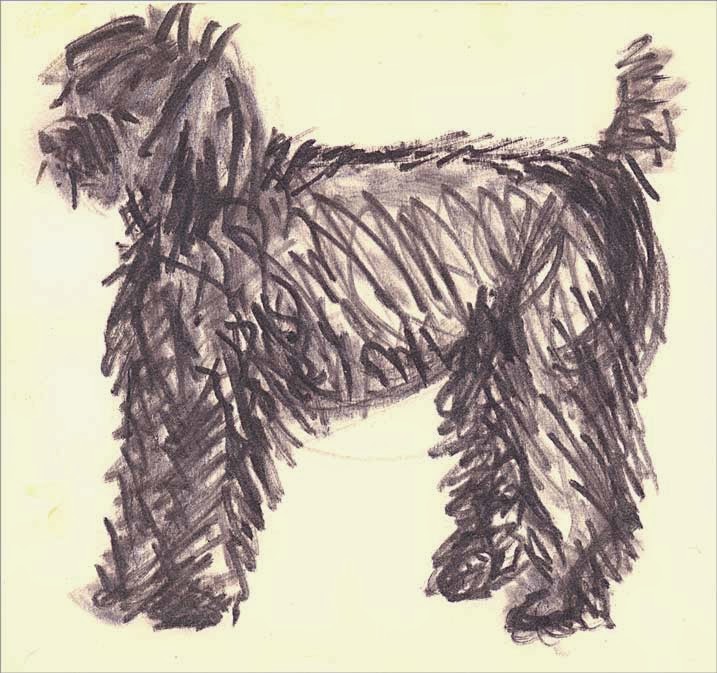
Here is a drawing of Beau just before his first haircut. The drawing was made by the owner of Beau's father, who also gave Beau his haircut.


Visit Sepia Saturday
For More Vintage Images

http://sepiasaturday.blogspot.com/2014/02/sepia-saturday-216-22-february-2014.html


Thursday, February 13, 2014

Hobble Skirt Cars on Broadway


This postcard shows a procession of hobble skirt cars on Broadway in New York City. the following information is from the back of the postcard:
The new surface cars now so numerous on Broadway were first introduced in 1914. The central portion of the cars is built close to the ground and the doors are in the center of the car, the steps being only about 6 inches from the ground.
This postcard was mailed in 1916. It has a picture that was used by more than one postcard publisher.  The picture can be dated 1914 from the sign advertising "Too Many Cooks" on the Kaiser Hof Bar/Cafe building on the right. "Too Many Cooks" was a comedy that opened Feb 24, 1914 and closed in September 1914.  Below is a review dated February 26, 1914.


Another sign on the building advertises the Shapiro Bernstein Co., an American music publishing company established in 1900 and still in existence.     

The hobble skirt cars would have made it easier for women wearing hobble skirts to enter, though by 1914 the hobble skirts had lost their popularity. Hobble skirts, that were narrow around the ankle and made movement difficult, were most popular around 1910-1913. The drawings below are from a 1910 New York Times article that called them "the latest freak in woman's fashions."


For More Vintage Images


http://sepiasaturday.blogspot.com/2014/02/sepia-saturday-215-15-february-2014.html


Saturday, September 21, 2013

Belarusian National Clothes on Stamps


This postcard shows stamps featuring Belarusian national clothes. These stamps date from 1995 to 2005. Belarus also has some newer stamps showing national clothing. The stamps on the postcard and also ones issued in 2011 and 2012 are listed and shown on the Belpost page  here

Belarus also has a joint issue with Azerbaijan of costumed folk dancers for 2013. The stamps feature dancers in native costumes of each country performing the national dances – Kryzhachok (Belarus) and Terekeme (Azerbaijan). (On the Azerbaijan sheet, the left and right images are reversed) The next image is from Wikipedia.


Kryzhachok is a Belarusian folk dance that is performed by any number of pairs. The complicated pattern of the dance resembles a geometric ornament. The name of the dance comes from the Belarusian word “kryzh” (cross). The dancing couples form an imaginary cross by their construction, by their hands etc. Terekeme is an ancient Azerbaijan folk dance.

If you are interested in reading about Belarusian national clothing, here is a link: Belarusian Traditional Clothing.

P.S. I just looked at the mail I got today and discovered I received an envelope with one of the 2011 Belarus costume stamps. This stamp has costumes of the Kalinkovichi region.


This is a post for Sunday Stamps at Viridian's Postcard Blog


Friday, March 23, 2012

Easter Greetings & Advertising


These chicks bring you Easter Greetings and an ad from Universal Tailoring Co. reminding you that Easter is a traditional time for new spring clothes.
Fair Easter hints of many things
As lovely as the rose—
Kind thoughts and gifts and lilies white
And folks in brand new clothes.


Wednesday, March 14, 2012

Vintage Girl Scout Uniform Fashions


The postcard above is a Girl Scout Camp Post Card that was mailed in 1947. A new uniform style was introduced in 1948 and was used until the early 1960s. That was the one that was in style when I was a Girl Scout.

The official Girl Scout website has a featured exhibit of Girl Scout Uniforms from 1912 to today. The exhibit covers the main styles, but the pictures are rather small and don't include all the variations. The type of uniform I had is shown in the next two pictures that are from my Girl Scout Handbook (© 1953). My uniform was secondhand and had long sleeves. Short sleeved uniforms must have been more common by that time--most of the other girls in my troop had uniforms with short sleeves. The following description is from the exhibit on the Girl Scout website:
Designed by the renowned Mainbocher, the Intermediate Scout uniform was a button-down-the-front dress well suited to Girl Scout needs. The bright green covert dress had an action back, button-down lapel tabs, deep armholes, a dark green web belt, and a six-gored skirt with pockets. The green beret was the official hat.


The next picture shows me (in the center) with my sisters. We were dressed in our uniforms to go to the 1960 father-daughter banquet. I was a Senior Scout then and was wearing the same dark green skirt and white blouse that I wore in junior high, but with a different cap and tie. I think this was considered an alternate uniform. Later I had a newer two piece green Senior Scout uniform that was introduced in 1960.


The next picture is a newspaper clipping I saved. This picture was taken before the father-daughter banquet and shows some of the girls from my Senior Scout troop modeling some of the vintage uniforms that were later worn in a fashion show at the banquet.


I was in the fashion show, but not in the newspaper photo. I once had some photos of the banquet, but I didn't save them. I did find a negative of the fashion show that has me in the picture. I am the girl on the far right in the picture below.


The video below, A salute to Girl Scout style (©1994), shows a more recent Girl Scout fashion show with old vintage uniforms and then current uniforms.


For More Vintage Images
Visit Sepia Saturday


Thursday, January 12, 2012

Vintage Millinery Modes


The postcard above shows a millinery room at Bullock's in Los Angeles. The postcard is from about 1915. The next group of images is from Home Craft: The American Woman's Handibook published by The Magazine Circulation Co, Inc., Publishers of Woman's Weekly ©1920.


The first image is one of several full page color images in the book. It is captioned "Fitting the Hat to the Season." The small image in the upper left corner shows a Winter hat. The images at the bottom are for (left to right) Spring, Summer, and Autumn.


Next are two images of historical American hat styles.


The next image shows "Five Distinctive Types of Headress worn by Women in American History." In the center is a photo of a 1921 Model Hat.


The book has ten pages on "Millinery Modes and Making" which include information on style selection, making hats, caring for hats, and children's hats and bonnets.

The following advice is offered on selecting a hat style:
Just as a frame may enhance or mar the effect of a picture, so a hat serves a woman's face, for the hat if properly chosen to conform with the shape of the face and head and with the fashion of hairdressing makes a most excellent background.

In choosing a hat we must bear in mind not only becomingness to the wearer but also the occasions on which it is to be worn, the season of the year and the style tendencies of the time.

The basic hat shapes are described as follows:
The toque, or brimless cap shape and the medium brimmed sailor are the two main forms from which all shapes are developed, and these two are almost universally becoming when modified to fit individual needs…The two other usual hat shapes are variations of the toque and sailor, for the turban is a toque with close turned brim, while the broad brimmed hat has both top and brim in exaggerated sailor form.
The next images illustrate the basic shapes of 1921 hats.


And suitable hats for children:


Finally, I have a more modern, but now quite old, photo of myself. I am wondering what Alan is going to pull out of the hat next.


Visit Sepia Saturday for more vintage images.


This week's Sepia Saturday prompt is from the movie
The New York Hat (1912)
Click the link above to watch the movie on YouTube


Wednesday, December 7, 2011

Christmas Greetings & Sailor Suits


The choice of the Christmas postcard shown above, with two boys wearing sailor suits, was prompted by the Sepia Saturday 104 photo of Princess Marie-Gabrielle of Bavaria and her young son Prince Luitpold dressed in dark sailor suits.

Sailor suits were especially popular for boys around the turn of the twentieth century. The beginning of this fashion trend has been attributed to the young Prince of Wales (the future King Edward VII). He was shown dressed in a sailor suit in an 1846 painting commissioned by Queen Victoria. The painting, which is shown below, is from the Royal Collection.


The next two photos are from the Bain Collection and also show royalty. The first is of the Russian Tsarevich Alexei Nikolaevich (1904 – 1918) of the House of Romanov. The second photo is of the Crown Prince of Spain Alfonso, Prince of Asturias (1907 - 1938). Both boys suffered from the disease of hemophilia. The Tsarevich was murdered with his family during the Russian Civil War by order of the Bolshevik government. Alfonso died from internal bleeding following a traffic accident.


The last photo is of future U.S. President Franklin Roosevelt. The photo shows him wearing a sailor suit at age seven in 1889. This is one of several 1889 photos of Roosevelt in a sailor suit in the Franklin D. Roosevelt Presidential Library and Museum collection.


For more vintage photos, visit Sepia Saturday


Monday, October 24, 2011

Minneapolis Knitting Works


These are postcards advertising babies' underwear made by Minneapolis Knitting Works. These have verses based on well-known nursery rhymes: Old Woman Who Lived in a Shoe; Pussy Cat, Pussy Cat; Jack and Jill; and Pat a Cake, Pat a Cake. There were also cards with Ba! Ba! Black Sheep and Mary Had a Little Lamb. The verses start out with the usual lines and end with something about the Minneapolis Knitting Works "M" products, for example:
Pat a cake, pat a cake, Baker's Man,
Bake me a cake as fast as you can.
Pat it and roll it and mark it "M.B."
Which stands for "M" Band for
Babies, you see.

Minneapolis Knitting Works began as the St. Paul Knitting Works. In 1891 St. Paul Knitting Works moved to Minneapolis and was reincorporated as Minneapolis Knitting Works. The company was located at 620-708 Bryant Avenue North for a long time.

The classified ad shown below is from a July 1920 Minneapolis Tribune and mentions a "new factory." The ad seems unusually long and makes the company sound like a great place to work. Among other things, it says: "In fact you will just smile away the hours, thinking of the good wages receive for such pleasant work, and go home happy and cheerful each day."


There are a number of old Minneapolis Knitting Works magazine ads shown on the web. One of my favorites is a colorful undated Halloween ad shown here. The latest ad that I saw was from 1953 and lists a Utica, New York address for the company instead of the Minneapolis address.

An article in the Utica Daily Press in January, 1952 announced that the manufacturing operations of the Minneapolis Knitting Works were to be transferred to Utica. The Minneapolis mill was described as a wholly-owned subsidiary of Utica Knitting Company. The Minneapolis line of children's and infants' garments was to supplement the Utica company's adult line. At that time, the Minneapolis label was not being replaced by the Utica label, and the Minneapolis comapny's offices were to remain in Minneapolis. The Minnesota Historical Society has a 1952 photo of the Minneapolis building here.


Monday, October 17, 2011

New Fall Hats - 1930s Style


This advertisement for fall hats from a "Big Hat Store" in downtown Minneapolis was printed on a government postal card and mailed September 14, 1936.

Many of the women's hats of the 1930s could be described as pert or perky and were worn at a jaunty angle. The style shown on the card seems typical of hats of the 1930s, fitting relatively close to the head and tilted to the side so that one eye and one ear were concealed.

Women needed hats in the 1930s in order to be considered properly dressed. Buying a new hat would have lifted their spirits in the midst of the depression. However, the $1.88 price that seems cheap today would have been equivalent to nearly $30 in 2011 dollars (DollarTimes Inflation Calculator).


Related Posts Plugin for WordPress, Blogger...